
If you found a listing for an African Grey at a fraction of the usual cost, would you see a bargain or a red flag? It’s completely natural to feel a bit anxious when the african grey parrot price seems to change on every website you visit. You’re looking for a healthy, talkative companion, but the fear of “too good to be true” offers or hidden shipping fees can make the process feel like a minefield. We know that bringing a parrot home isn’t just a transaction. It’s welcoming a highly intelligent new family member who will be by your side for decades.
You’re right to worry about the difference between a budget bird and a well-adjusted, hand-reared one. This guide will clarify the real factors behind current market values, including why the Congo and Timneh subspecies carry different price tags. You’ll learn how to spot a legitimate breeder, understand the importance of CITES documentation, and get a realistic look at the costs of a bird’s first year. We’ll provide a clear breakdown of the market and the value of expert socialization. By the end, you’ll have a clear roadmap to making a responsible and heart-led investment in your future feathered friend.
Key Takeaways
- Learn to distinguish between the larger Congo and the smaller Timneh subspecies and how these physical differences influence current market availability.
- Understand why a realistic african grey parrot price reflects a significant investment in expert hand-rearing and decades of specialized breeding experience.
- Prepare a practical first-day budget by exploring the essential costs for high-quality cages, avian-specific lighting, and premium nutrition.
- Identify the specific verification steps, such as requesting live video calls, that protect you from common “too good to be true” online scams.
- Discover how professional socialization processes create a tame, playful companion that is ready to bond with your family from the moment they arrive.
The Current Market Price for African Grey Parrots
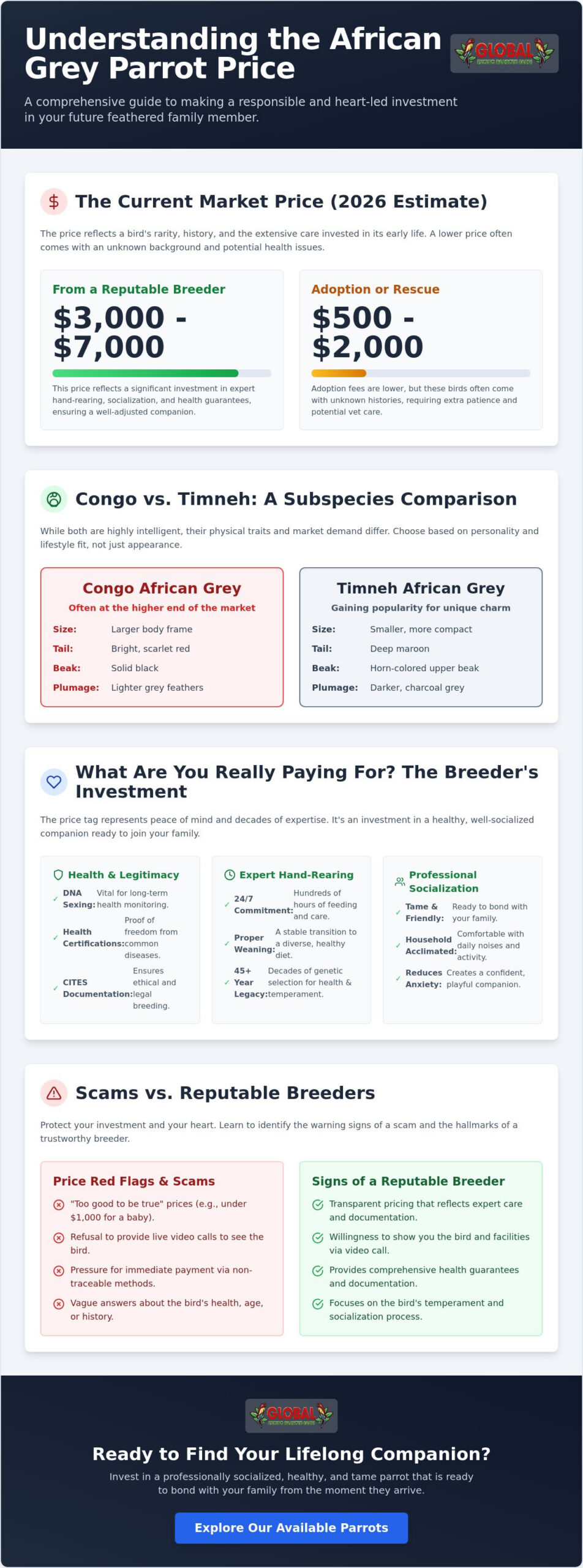
Bringing a grey into your home is a decision that spans decades. It’s about finding a soulmate with feathers. When you look at the african grey parrot price in 2026, you’ll see a wide spectrum that reflects the bird’s rarity and the care put into its early life. The Congo African Grey is a larger bird with a bright red tail and black beak, while the Timneh is smaller, charcoal-grey, and features a maroon tail with a horn-colored upper beak. While market experts often cite ranges between $3,000 and $7,000 for birds from established breeders, the true value lies in the bird’s health and history. Adoption fees are usually lower, sitting between $500 and $2,000, but these birds often come with unknown backgrounds.
Beyond the initial number, you’re paying for peace of mind. A reputable breeder’s valuation includes essential steps that protect your investment and your heart. These typically include:
- DNA Sexing: Knowing if your new friend is a boy or a girl is vital for long-term health monitoring.
- Health Certifications: These documents prove the bird is free from common avian diseases like PBFD or Polyomavirus.
- CITES Documentation: Legal proof that your bird was bred ethically and follows international regulations.
It’s a small price for a healthy start. Starting your journey with a bird that has a clean bill of health saves you from heartbreak and expensive emergency vet bills later on.
Congo vs. Timneh: Does the Subspecies Affect the Price?
Congo Greys often sit at the higher end of the market because they are the iconic image of the species. They’re larger and highly sought after by those who want the classic scarlet tail. However, Timnehs are becoming incredibly popular for their unique charm. They often mature faster and can be more adaptable in busy households. You should choose based on which bird’s personality matches your lifestyle. A Timneh’s maroon tail and smaller frame might be exactly what your family needs, regardless of the sticker price.
The Price of Weaning: Why “Ready-to-Go” Birds Cost More
The most significant part of the african grey parrot price comes from the weaning process. Hand-feeding a baby bird is a 24/7 commitment that requires waking up at all hours and monitoring growth with expert precision. When you buy a bird that is ready to go, you’re paying for those hundreds of hours of labor. Beginners often see unweaned chicks for less and feel tempted. Please, don’t take that path. A bird that is already transitioned to a diverse diet of pellets, seeds, and fresh produce has a much higher chance of a long, healthy life. It’s an investment in their future stability.
Why Do African Grey Prices Vary? The Breeder Investment
You might wonder why one african grey parrot price looks like a bargain while another feels like a significant investment. The truth lives in the years of dedication behind the bird. A 45-year legacy of breeding isn’t just a statistic. It represents decades of genetic selection aimed at health, temperament, and longevity. When you choose a bird from a seasoned expert, you’re paying for the certainty that your companion comes from a lineage of stable, thriving parents. This deep experience allows a breeder to spot the tiniest shifts in a chick’s development, ensuring every bird reaches its full potential before joining your family.
Early human interaction is the defining factor that shapes a parrot’s lifelong behavior and its ability to bond with a human family. This isn’t a process that can be rushed or automated. It requires hundreds of hours of gentle handling, spoon-feeding, and play. A tame, friendly bird is the result of a breeder who has made that bird a part of their daily life from the moment it hatched. This upfront time investment is what creates a parrot that seeks out your company rather than hiding in the corner of its cage.
The Science of Hand-Rearing and Socialization
Our approach to socialization focuses on preparing birds for real-world environments. We raise our Greys to be comfortable around the sounds of a busy household, from television noise to the laughter of children. This intentional exposure helps the bird develop the confidence needed to mimic speech and household sounds early on. A “cheap” bird is often one that was parent-raised with little human contact or, worse, wild-caught. These birds often struggle with anxiety and may never truly bond with their owners. If you want a bird that is truly ready to become a family member, the socialization process is where the real value lies.
Veterinary Standards and Health Clearances
The purchase price also covers a rigorous medical protocol that protects your home from heartbreak. Every chick should undergo comprehensive avian vet checks, including screening for PBFD and Polyomavirus. These are not just “quick looks” by a general vet. They are specialized laboratory tests that confirm the bird is biologically healthy. There’s a massive difference between a bird that has been “checked” and one that is “certified healthy” with documented lab results. A reputable breeder provides these health guarantees as part of the package. It acts as an insurance policy, giving you the peace of mind that your new friend is starting their 60-year journey with a clean bill of health.
Beyond the Bird: Estimating Your Initial Setup Costs
Bringing your new companion home is an emotional milestone. It’s also the moment when your planning turns into reality. While the initial african grey parrot price covers the bird itself, you must prepare for the “First Day” budget to ensure their transition is seamless. A happy parrot needs more than just a place to sleep. They require a stimulating environment that respects their high IQ. When calculating the total african grey parrot price, many first-time owners overlook the importance of an emergency fund. Avian medicine is a specialized field. Setting aside a few hundred dollars for annual wellness exams and unexpected tests is a mark of a responsible guardian.
Your shopping list should include several vital items to keep your bird safe and engaged:
- Natural Wood Perches: Avoid uniform dowels. Varied textures prevent foot sores and arthritis.
- Foraging Toys: Greys are thinkers. They need puzzles that challenge them to earn their treats.
- Avian-Safe Cleaners: Their respiratory systems are incredibly delicate. You’ll need specialized, non-toxic solutions for their cage and bowls.
- Travel Carrier: A sturdy, well-ventilated carrier is essential for safe transport to the vet or during family moves.
Nutrition is another non-negotiable expense. A diet consisting only of seeds is a recipe for a short life. You’ll need premium pellets as a base, supplemented daily with fresh greens, sprouts, and the occasional fruit. Budgeting for these recurring costs ensures your bird stays vibrant and energetic for the next 60 years.
Housing Your Grey: Cage Quality vs. Price
Don’t be tempted by the lowest price tag on a generic cage. Many cheap options use coatings containing lead or zinc. Greys love to use their beaks to climb; ingesting these metals is often fatal. For a Congo African Grey, you’ll want a cage at least 36 inches wide. Timnehs can thrive in slightly smaller spaces, but more room is always better. Investing in a powder-coated or stainless steel “forever cage” from the start is actually cheaper than replacing a flimsy, rusted one every two years.
Specialized Equipment: Incubators and Brooders
Some enthusiasts choose a different path by starting with fertile parrot eggs. This is a deeply rewarding experience but requires specialized hardware. High-quality incubators and brooders are essential to maintain the precise temperature and humidity needed for a successful hatch. At Global Exotic Parrots Farm, we don’t just offer birds. We also provide the same professional-grade incubators and specialized equipment we use in our own facility. Hatching your own can lower the upfront bird cost, but it demands a much higher investment in equipment and round-the-clock care. Whether you’re buying a weaned bird or exploring incubation, having the right gear is the secret to success.
Identifying Price Red Flags: Scams vs. Reputable Breeders
We’ve all seen them. You’re browsing online and stumble across a beautiful photo of a bird with a price that feels like a gift. But in the world of exotic birds, a $500 offer is a heartbreak waiting to happen. The legitimate african grey parrot price reflects the high cost of ethical breeding, specialized nutrition, and legal compliance. When a listing is significantly lower than the market averages we discussed earlier, it’s almost certainly a scam. These predators rely on your emotional desire for a companion to cloud your judgment. A real breeder will never rush you into a “limited time” deal or pressure you to pay before they’ve even spoken with you.
A reputable breeder cares deeply about where their babies are going. They will ask you questions about your home, your experience with birds, and your daily schedule. If the person on the other end is only interested in your credit card number, walk away. You should also look for specific legal protections. Because African Greys are protected under CITES Appendix I, every legal sale must include a CITES Article 10 certificate. This document is your proof that the bird was bred in captivity and is legally yours to own. Without it, you could face serious legal issues, and the bird could even be seized.
The Anatomy of an Online Parrot Scam
Scammers use a predictable playbook. They often steal high-quality photos from legitimate websites or social media pages. A great way to verify a bird is to ask for a live video call. If they make excuses about “unstable internet” or “disturbing the bird,” they likely don’t have the bird at all. Another massive red flag is the promise of free shipping. Transporting an exotic bird requires climate-controlled environments and direct flights, which are never free. They might also ask for “refundable” insurance fees once the bird is supposedly at the airport. These fees are fake and will never be returned. If you want to avoid these traps, choose a breeder with a verified 45-year legacy of excellence and transparency.
Safe Payment and Shipping Procedures
Protecting your money is just as vital as protecting your heart. Never use untraceable wire transfers, gift cards, or apps that offer no buyer protection. Reputable breeders use secure, professional payment methods that leave a paper trail. When it comes to shipping, the process should be transparent from start to finish. You should receive a specific flight number, a tracking ID from a known airline, and clear instructions on how to pick up your new family member. Professional avian shipping involves specialized crates and a focus on minimizing stress. Throughout the transit, a good breeder will stay in constant contact, giving you peace of mind until that first chirp fills your home.
The Lifetime Value of a Global Exotic Parrots Farm Grey
Choosing a companion that can live for sixty years is a monumental decision. It’s about more than just the initial african grey parrot price; it’s about the quality of life you’ll share together. At Global Exotic Parrots Farm, our 45-year commitment to avian excellence means we don’t just hatch birds. We nurture future family members. When you bring home one of our Greys, you’re gaining the peace of mind that comes with a health-guaranteed, DNA-sexed companion who has been loved from day one. Our relationship with you doesn’t end when the carrier door closes. We provide ongoing support to ensure your new friend thrives in their new environment.
When you look back ten years from now, you won’t remember the exact african grey parrot price you paid. You’ll remember the first time your Grey mimicked your laugh or the quiet moments they spent perched on your shoulder. That’s the real return on investment. Our legacy is built on these success stories. We take immense pride in the cleanliness of our facilities and the high standards of our breeding stock. Every bird is a testament to our passion. We aren’t just selling a parrot; we’re guiding you toward a life-changing relationship. This is why we insist on rigorous health clearances and DNA sexing for every bird we raise. It’s about starting your journey on the right foot.
Hand-Trained and Family-Ready
Our “Tame and Playful” promise isn’t just a slogan. It’s a daily practice. We spend hours every day interacting with our chicks to ensure they are family-ready. This means they’ve been exposed to different people, gentle handling, and even the presence of children. A well-socialized bird is a confident bird. They’re more likely to talk, play, and integrate into your daily routine without the fear-based behaviors seen in poorly raised parrots. By choosing a weaned bird from us, you’re choosing a companion who is ready to bond with you immediately. Our support system helps you maintain this bond through:
- Guidance on diet and nutrition transitions.
- Advice on cage placement and environmental enrichment.
- Tips for early speech training and bonding exercises.
- Lifelong access to our breeding expertise.
A Legacy of Trust in Exotic Bird Breeding
Trust is earned over decades, not days. Having 45 years in the industry allows us to refine our breeding protocols to the highest standards. This long history translates directly into healthier, happier birds for our clients. We’ve developed a global shipping network that prioritizes the safety and comfort of your parrot above all else. We handle the complex logistics so you can focus on preparing your home. We stay in contact until your bird is safely in your arms. View our healthy, hand-reared African Grey Parrots for sale today and start your journey with a breeder who cares as much about your bird as you do.
Starting Your 60-Year Journey with Confidence
Choosing a parrot is about much more than a simple transaction. It’s about inviting a soulmate into your life who will grow alongside your family for decades. We’ve explored how subspecies choice, the delicate weaning process, and expert socialization create a bird that is truly ready for a home like yours. Remember that a realistic african grey parrot price is your best defense against the heartbreak of online scams and hidden medical issues. It’s an investment in a bird that has been nurtured with love and professional precision from the very first day.
We’re proud to offer the security of our 45 years of breeding experience to every new owner. Every one of our birds comes with health guarantees on all weaned birds, and we ensure they arrive safely through our worldwide climate-controlled shipping. Whether you’re looking for a hand-reared Congo or Timneh, or even high-quality fertile eggs for your own incubator, we are here to support your journey as a responsible guardian. Your new best friend is waiting to fill your home with chatter and joy. We can’t wait to help you make that beautiful dream a reality.
Browse Our Hand-Reared African Grey Parrots and Fertile Eggs
Frequently Asked Questions
How much does an African Grey parrot cost on average in 2026?
The average market price for a healthy, hand-reared bird from a reputable breeder typically ranges between $3,000 and $7,000. Some specialized listings for baby birds with exceptional pedigrees can reach as high as $8,500. If you choose to adopt from a rescue, fees are significantly lower, usually falling between $500 and $2,000.
Why are African Grey parrots so expensive compared to other birds?
Their high price reflects their incredible intelligence, 60-year lifespan, and the complexity of breeding them in captivity. They are also listed under CITES Appendix I, which requires strict legal documentation and ethical standards that increase the breeder’s overhead. You’re investing in decades of companionship rather than just a pet.
Is there a price difference between male and female African Greys?
Most professional breeders don’t distinguish between males and females when setting a price. The real value is in the DNA sexing process itself. This lab test is essential for your future health planning and understanding certain hormonal behaviors as the bird matures.
What is the annual cost of owning an African Grey after the initial purchase?
You should budget between $1,500 and $3,000 per year for your bird’s ongoing care. This covers premium pellets, a variety of fresh produce, and frequent toy replacements to keep their active minds busy. It also includes the cost of an annual wellness exam with a specialized avian veterinarian.
Can I buy an African Grey parrot egg for a lower price?
Buying fertile eggs is a more affordable way to start, but it carries much higher risks for beginners. You’ll need to invest in professional-grade incubators and brooders to ensure a successful hatch. It also requires the skill to manage round-the-clock hand-feedings, which is a delicate and exhausting process.
What should I look for in a breeder to ensure the price is fair?
A fair price must include a CITES Article 10 certificate, documented health screenings for diseases like PBFD, and proof of socialization. Look for a breeder who asks you detailed questions about your lifestyle. This shows they care more about the bird’s future than a quick sale.
Does the price of an African Grey include shipping and CITES permits?
Legal CITES permits should always be included in the purchase price as they are required for a legal sale. Shipping is almost always an additional cost. It requires specialized, climate-controlled crates and direct flights to ensure the bird stays safe and stress-free during the journey.
Are Timneh African Greys cheaper than Congo African Greys?
Timnehs were once slightly more affordable, but their popularity as adaptable, family-friendly companions has balanced the market. While the african grey parrot price for a Congo might still be slightly higher due to their larger size and iconic red tail, the difference is often minimal in the current market.